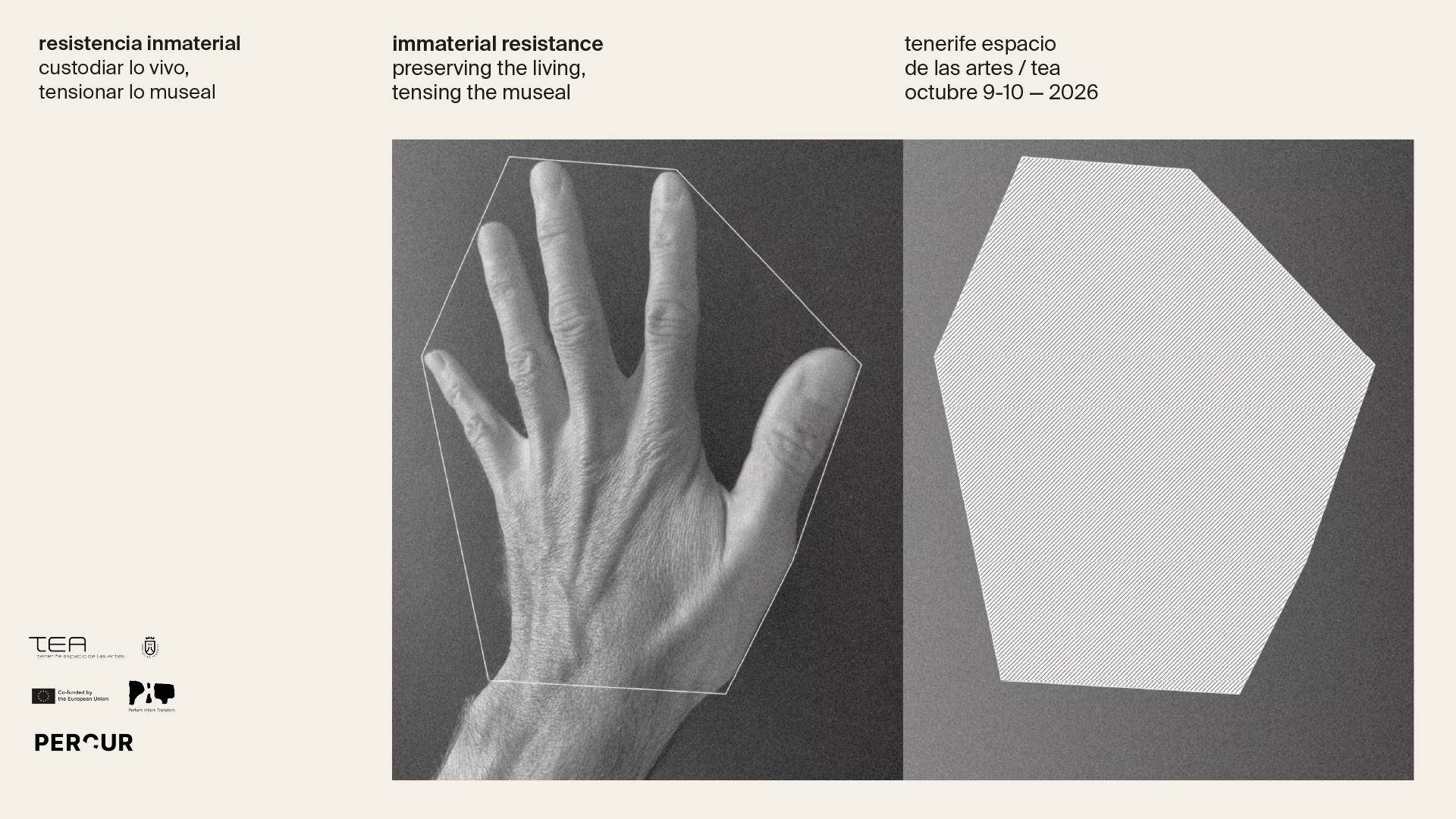
Immaterial Resistance: Preserving the Living, Tensing the Museal
TEA (Tenerife Espacio de las Artes), Santa Cruz de Tenerife
9-10 de octubre de 2026
[scroll down for english version]
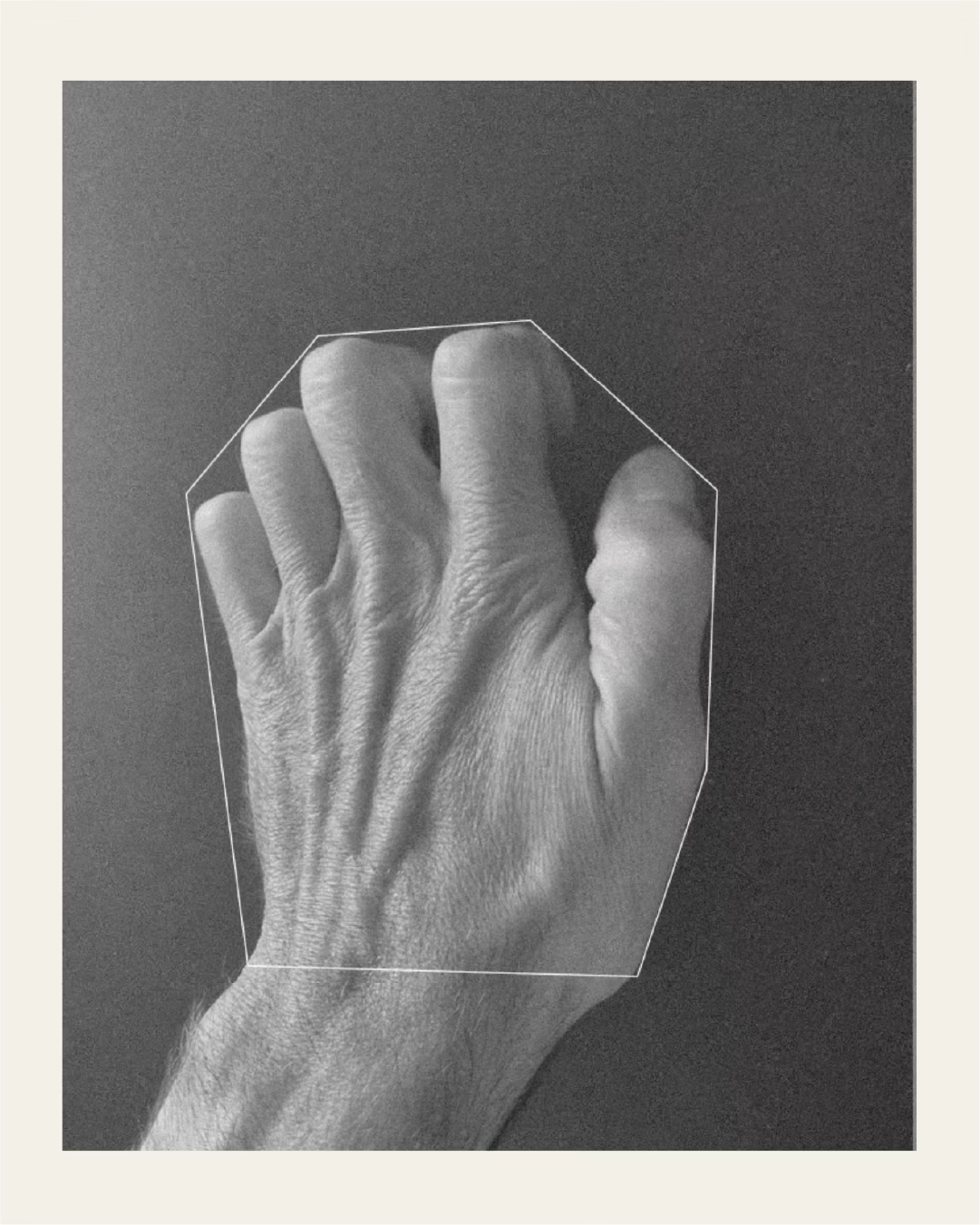
Desde los tiempos de las vanguardias históricas, los museos se han visto desafiados por una panoplia de prácticas que tensionaban sus estructuras y objetivos. Propuestas de una materialidad poco convencional, infraleves, performances, danzas, objetos encontrados, etc. parecían proponer formas de resistencia ante los procesos de cosificación inherentes al acto de coleccionar arte. En los últimos 25 años, instituciones de todo el mundo han hecho un considerable esfuerzo por desarrollar prácticas y protocolos que permitiesen incorporar piezas inmateriales –performances, coreografías, instrucciones, propuestas conceptuales, etc.– a sus acervos y programas. La normalización de las artes vivas en el circuito internacional ha impulsado una reflexión sobre la necesaria puesta al día de los museos en sus labores de custodia, exposición y mediación. Cada infraestructura, en su tejido cultural, debe confrontarse con problemas institucionales y agendas políticas diferentes. Pese a algunos esfuerzos previos, en el contexto español y, específicamente, canario todavía está pendiente una reflexión en profundidad sobre estas cuestiones. Resistencia inmaterial pretende reunir a profesionales, agentes e investigadorxs provenientes de ámbitos y geografías diferentes con el objetivo de contrastar y poner en diálogo experiencias desde las que cimentar una necesaria transformación institucional. ¿Cuáles son los principales retos que “lo vivo” plantea a los museos y centros de arte contemporáneo?, ¿qué actualizaciones deben llevar a cabo las instituciones para responder a esos desafíos?, ¿en qué medida se están convirtiendo los museos en organismos vivos y cómo pueden generar una memoria performativa de sus programaciones?, ¿qué prácticas archivísticas podrían tomar como referencia en el empeño de incorporar lo inmaterial?
Viernes: 9 de octubre de 2026
10,15 h. Presentación
10,30-11,30 h. Hanna B Hölling, After Permanence: Museums, Critical Ethics and the Work of Care [inglés con traducción simultánea]
11,45 h. Descanso
12,15-13,15 h. Diálogo: Amanda de la Garza y Laia Estruch
13,30 h. Pausa
16,00-17,00 h. Lou Forster, Dance Literacy at the Museum [inglés con traducción simultánea]
17,15 h. Descanso
18,00-19,00 h. Diálogo: Oscar Dasí, Blanca Molina y Carmelo Salazar
19,30 h. Performance: Itziar Okariz, Respiración oceánica
Sábado: 10 de octubre de 2026
10,30-11,30 h. Bianca Tinoco, La performance en el museo: caminos para la inserción de acciones en colecciones de arte
11,45 h. Descanso
12,15-13,15 h. Diálogo: Catalina Lozano e Itziar Okariz
13,30 h. Pausa
16,00-17,00 h. Hélia Marçal, Post-anthropocentric performance transmission [inglés con traducción simultánea]
17,15 h. Descanso
18,00-19,00 h. Diálogo: Tania Pardo, Cuqui Jerez y María Jerez
19,15 h. Conclusiones y cierre
Coordinación: Juan Albarrán, Javier Arozena, Olga Fernández López
* En colaboración con el proyecto de investigación PERCUR Performance y curadoría: transformaciones performativas del comisariado, el coleccionismo y la espectaduría desde una perspectiva comparada: España, Portugal, Brasil y Argentina, 2003-2028 (Universidad Autónoma de Madrid, PID2024-156472NB-I00).
** Este seminario se inscribe en el marco del proyecto europeo PIT (Perform, Inform, Transform), financiado por el programa Europa Creativa de la Unión Europea, del que TEA es el único museo español participante. Esta red internacional reúne a instituciones como Serralves, Bozar, MUDAM, CAC Vilnius y Triennale Milano con el objetivo de investigar nuevas formas de activación performativa que fortalezcan el vínculo entre la ciudadanía, el cuerpo y las instituciones culturales, favoreciendo procesos participativos, intergeneracionales y comunitarios. Financiado por la Unión Europea. No obstante, los puntos de vista y opiniones expresados son exclusivamente los de su(s) autor(es) y no reflejan necesariamente los de la Unión Europea ni los de la Agencia Ejecutiva Europea de Educación y Cultura (EACEA). Ni la Unión Europea ni la EACEA pueden ser consideradas responsables de ellos.
Bios
Juan Albarrán es profesor titular en el Departamento de Historia y Teoría del Arte de la Universidad Autónoma de Madrid. Sus líneas de investigación se centran en las prácticas y discursos artísticos de la contemporaneidad, especialmente en las relaciones entre arte y política en España desde la transición, las teorías de la fotografía y la performance y las representaciones de la violencia en la cultura visual contemporánea. Sobre estas cuestiones, ha publicado los libros Ficción a muerte. Sobre performance y novela (2026), Ojos vendados. Tortura y representación en la cultura visual contemporánea (2023), Disputas sobre lo contemporáneo. Arte español entre el antifranquismo y la postmodernidad (2019) y Performance y arte contemporáneo. Discursos, prácticas, problemas (2019).
Javier Arozena es performer, curador e investigador de Artes Vivas. De 2022 a 2025 es curador del Programa Público de Artes Vivas “POR ASALTO” en TEA Tenerife Espacio de las Artes. En 2024 es comisario de la exposición “Este puede ser el lugar, performar el museo” junto a Natalia Álvarez Simó, presentada en TEA Tenerife Espacio de las Artes y en Centro de Cultura Contemporánea Condeduque. En 2025 inicia la curaduría y coordinación de Artes Vivas del equipo de TEA Tenerife Espacio de las Artes como parte del Programa, con fondos Creative Europe, P.I.T. (Perform – Inform – Transform). Desarrolla su práctica escénica desde 2001 como intérprete, creador y docente en compañías nacionales, europeas y norteamericanas. Actualmente forma parte de Dance On Ensemble (Berlín). Desde 2019 forma y co-dirige junto al arquitecto Gino Senesi el tándem creativo la compañía – javier arozena con un repertorio de trabajos coreográficos para espacios escénicos y otros espacios de exhibición.
Oscar Dasí es bailarín y coreógrafo. Ha colaborado como intérprete con numerosos creadores y compañías nacionales e internacionales, también ha desarrollado sus propias creaciones escénicas y proyectos de vídeo danza. En 1993 entra a formar parte del colectivo La Porta Barcelona (Premio Nacional de Danza de Cataluña 2012), donde asume junto a Carmelo Salazar la dirección artística y la coordinación de proyectos de apoyo y difusión de la creación escénica contemporánea, hasta su disolución en 2013. En 2017 es nombrado director artístico de La Caldera – Centro de creación de danza en Barcelona, cargo que ocupa hasta finales de 2024.
Laia Estruch es artista, licenciada en Bellas Artes por la Universitat de Barcelona. Estudió su último año de licenciatura en la Universidad The Cooper Union (New York, 2010). La voz y el cuerpo son los elementos que vertebran la investigación de Laia Estruch, una práctica artística situada a caballo entre la escultura y la acción. La artista entiende la voz como una extensión del cuerpo capaz de sintetizar cuestiones relativas al lenguaje, al habla, al género o a las estructuras sociales. En su trabajo más reciente, la artista ha investigado cómo los espacios urbanos y sus estructuras físicas juegan un papel importante en la vida cotidiana. Utilizando el ‘spoken word’, la canción, los objetos y las publicaciones, sus proyectos analizan las posibilidades emotivas de la voz a cappella y el cuerpo sin teatralizar, abriendo un espacio de reflexión en relación al carácter performativo del lenguaje, la grabación sonora y su archivo oral.
Olga Fernández López es profesora titular en el Departamento de Historia y Teoría del Arte de la UAM, donde imparte docencia en los campos de la historia del arte contemporáneo (siglos XX y XXI) y los estudios curatoriales. Antes de incorporarse a la UAM, impartió clases como profesora invitada en el MA Curating Contempory Art del Royal College of Art (Londres). Sus líneas de investigación se centran en la historia de las instituciones artísticas contemporáneas, las especificidades el medio expositivo, las posibilidades críticas de la práctica curatorial y la historia de los públicos. Autora del libro Exposiciones y comisariado. Relatos cruzados (Cátedra, 2020), ha comisariado la exposición Mil bestias que rugen. Dispositivos de exposición para una modernidad crítica (2017, Centro andaluz de arte contemporáneo) y el programa Comunidades inestables (2016, Intermediae-Matadero).
Lou Forster es comisario, dramaturgo y doctor en Historia del Arte. Su trabajo se sitúa en la intersección entre la danza, las artes visuales y las ciencias sociales. Su investigación ha contribuido especialmente al redescubrimiento de la obra gráfica de Lucinda Childs, a la que dedica una exposición monográfica en tres partes, presentada en el Frac Bretagne, el Frac Franche-Comté y Le Lait, en Albi, del 29 de enero de 2026 al 7 de marzo de 2027. Su libro, Page in Hand: Lucinda Childs and Dance Literacy, fue publicado en francés por Macula en junio de 2026. Lou Forster dirige el Departamento de Patrimonio, Audiovisual y Edición del Centre National de la Danse y es investigador asociado en la Escuela de Estudios Avanzados en Ciencias Sociales (EHESS).
Amanda de la Garza es actualmente subdirectora artística en el Museo Nacional Centro de Arte Reina Sofía. Es Presidenta del CIMAM (International Committee for Museums and Collections of Modern Art) para el periodo 2026-2028. De 2020 a 2024 fungió como directora general de Artes Visuales y del Museo Universitario Arte Contemporáneo (MUAC) de la UNAM en la Ciudad de México, una de las instituciones culturales más importantes de América Latina. Formada en Estudios curatoriales, Historia del Arte, Antropología y Sociología, entre 2012 a 2019 trabajó curadora adjunta en el MUAC. Ha comisariado y coordinado más de 30 exposiciones de arte moderno y contemporáneo, de archivo, así como proyectos de arte público. Ha publicado ensayos, entrevistas y reseñas en catálogos, libros y revistas especializadas. Fue integrante de la mesa directiva de ICOM México de 2021 a 2024.
Hanna B. Hölling es profesora de investigación en la HKB Bern University of the Arts y Senior Fellow en el Collegium Helveticum de Zúrich. Su investigación, publicaciones y docencia abordan cuestiones relacionadas con los estudios de cultura material, la historia y la teoría de la conservación, y la historia del arte desde mediados del siglo XX. Entre sus libros se encuentran los dos volúmenes de Performance: The Ethics and the Politics of Conservation and Care (Routledge, 2023 y 2025), Activating Fluxus, Expanding Conservation (Routledge, 2026), Paik’s Virtual Archive: Time, Change and Materiality in Media Art (University of California Press, 2017) y Revisions: Zen for Film (Bard Graduate Center, 2015). Ha sido investigadora principal (PI) de varios proyectos financiados por el SNSF, entre ellos, más recientemente, Critical Conservation (2025-2030), y ha dirigido el Center for Critical Conservation y el Natureculture Lab.
Cuqui Jerez es artista, coreógrafa y performer. Después de trabajar como bailarina e intérprete con diversos coreógrafos en Europa en los años noventa, comienza a desarrollar su trabajo coreográfico en 2001. Desde entonces ha creado piezas escénicas que se han presentado en numerosos festivales en Europa, EEUU y Latinoamérica. Su principal actividad es la creación, pero también participa en diversos proyectos de investigación, curatoriales, de docencia y publicaciones. Desde 2020 forma parte de Dorothy Michaels – Oficina de producción e investigación artística en Madrid.
María Jerez trabaja “entre” la coreografía, el cine y las artes visuales. Más allá del interés en sus primeras piezas por las convenciones teatrales y cinematográficas, y la comprensión implícita del espectador de las mismas, en sus últimos trabajos busca cuestionar esta relación abriendo espacios de potencialidad a través de encuentros con aquello que encontramos extraño y ajeno, estableciendo bordes difusos entre lo conocido y lo desconocido, el objeto y el sujeto, lo orgánico y lo artificial, lo animado y lo inanimado. Su trabajo trata de escapar de las lógicas logocéntricas y antropocéntricas, donde el propio conocimiento humano se convierte en un algo vulnerable ante otros ecosistemas enigmáticos y complejos. María Jerez combina la producción de su trabajo artístico con proyectos pedagógicos, curatoriales y editoriales. Es parte de la oficina colectiva de producción e investigación Dorothy Michaels.
Catalina Lozano es curadora jefe del Museo de Arte Contemporáneo del País Vasco, Artium Museoa desde 2022. Fue co-comisaria de Hasta que los cantos broten (Pabellón de México en la 59a Bienal de Venecia, co-curada con Mauricio Marcin). Como comisaria independiente ha desarrollado proyectos en Pivô, São Paulo; TEA, Tenerife; CRAC Alsace, Altkirch; CentroCentro, Madrid; CAPC, Burdeos, entre otros. Entre 2020 y 2022 fue Directora de Programas para Latinoamérica en KADIST y entre 2017 y 2019 se desempeñó como curadora asociada en el Museo Jumex en la Ciudad de México. Lozano hizo parte del equipo artístico de la 8ª Bienal de Berlín en 2014.
Hélia Marçal es investigadora adjunta en el Instituto de Historia del Arte (NOVA FCSH / IN2PAST), así como profesora asociada en el Departamento de Historia del Arte del University College London y vicedecana para el Bicentenario / UCL200 Champion de la Facultad de Ciencias Sociales e Históricas (hasta julio de 2026). Fue Visiting Fellow en el Victoria and Albert Research Institute (2024-2025), investigadora junior en el Instituto de Historia Contemporánea (2021-2025), e investigadora en los proyectos Reshaping the Collectible: When Artworks Live in the Museum (2018-2020) y Documentation and Conservation of Performance (2016-2021), ambos desarrollados en la Tate. Ha publicado sobre poshumanismo y prácticas de conservación y cuidado de colecciones en museos, y es investigadora principal (PI) del proyecto RESONANCE: Epistemologies for Documentation of Affects and Becoming in Cultural Manifestations in Performance (1969-1979), financiado por FCT, PORTUGAL2030 y LISBOA2030.
Blanca Molina es graduada en Historia del Arte (UM, 2019) y Máster en Historia del Arte Contemporáneo y Cultura Visual (UAM, UCM, Museo Reina Sofía, 2020). En el marco de una ayuda para la Formación de Profesorado Universitario (FPU20/01347) desarrolla una tesis doctoral en torno a la institucionalización, comisariado y recepción de la danza contemporánea en museos y centros de arte españoles. En torno a este tema ha realizado publicaciones como: «Propuestas performativas y procesos de subjetivación: públicos, experiencias y dispositivos» (con Juan Albarrán, 2024), «Institucionalización, comisariado y recepción de la danza contemporánea en la exposición DANCE?» (2022), «20 Dancers for the XX Century. El Museo Reina Sofía ¿Un museo danzante?» (2021) y «Bailando en el Museo Reina Sofía. El Judson Dance Thater, más allá de la danza minimalista» (2021).
Itziar Okariz trabaja en el marco de la acción y la performance. Su obra –performances vocales, acciones, videos, instalaciones y piezas de texto– examina los vínculos entre arquitectura, territorio, cuerpo, ritual, sexualidad y semiótica. A menudo está asociada con las prácticas feministas, el punk-rock y la crítica queer de las construcciones normativas de género. En los últimos años, su práctica ha estado ligada a las formas de transmisión y pedagogías del arte. Entre sus performances y proyectos se encuentran; La lechuza de Minerva, Círculo de Bellas Artes, Madrid 2026. BienalSur, Rome (2025), Dream Diary and Ocean Breath, Western Front, Vancouver (2025), Ametsak, Feministaldia, Donostia. Carrusel, Junto a Fuentesal-Arenillas: Condeduque. Madrid. (2025). ¡I am afraid that Rome existed! MAXXI, Museo nazionale delle arti del XXI secolo, Rome (2024). Dream Time: UCCA Center for Contemporary Art Beijing (2024), XXIII Bienal de arte Paiz Ciudad de Guatemala (2023), Processi 150, Real Academia de España, Roma (2023), Playbill, Torpedo Theater, Amsterdam (2022).
Tania Pardo es licenciada en Historia del Arte por la Universidad Autónoma de Madrid. Es comisaria e investigadora, actualmente es directora del Museo Centro de Arte Dos de Mayo de la Comunidad de Madrid donde previamente fue subdirectora y asesora de Artes Plásticas de la Comunidad de Madrid (2019-2023). Anteriormente, fue responsable del departamento de Exposiciones de La Casa Encendida, de Madrid (2015-2019). También ha sido comisaria en MUSAC, Museo de Arte Contemporáneo de Castilla y León y responsable de programación del espacio Laboratorio 987 de la misma institución. Ha sido directora de proyectos de la Fundación Santander 2016 (2009-2010) y profesora de Historia del Arte en la Universidad Complutense de Madrid (2014-2020). Actualmente es profesora del Master de Estudios Curatoriales de la Universidad de Navarra y del Máster de Gestión Cultural de la Carlos III.
Carmelo Salazar es coreógrafo, desarrollador pedagógico, Bailarín y artista visual. Ha desarrollado su labor creativa entre Canarias y Barcelona principalmente. Ha estudiado danza contemporánea en el instituto del teatro de Barcelona. Ha realizado el programa de estudios independientes (PEI) del Macba. Ha sido becado por el Ministerio de cultura y la Generalitat de Cataluña para estudiar arte de acción, danza release y contact – improvisation en Nueva York. Carmelo inicia su labor creativa en 1992 y desde entonces ha realizado un gran número de coreografías, video creaciones y acciones que van desde la construcción de solos a trabajos grupales. Su trabajo ha podido verse en diferentes festivales teatros nacionales y museos, así como en contextos internacionales. Ha sido, hasta el 2015, director de la agencia de producción cultural La Porta, por cuya gestión ha recibido el Premio Ciudad de Barcelona y el Premio Nacional de Cultura por el Ministerio de Cultura. www.laportabcn.com Ha sido co.director de las tres ediciones del Festival de danza LP http://laportabcn.com/en/activities/LP. Co-fundador de Teatrón, web social de acceso libre que permite y fomenta la relación y el intercambio en la comunidad escénica contemporánea. www.tea- tron.com
Bianca Tinoco es investigadora posdoctoral en el Museo de Arte Contemporáneo de la Universidad de São Paulo (2026-2027). Profesora voluntaria en el Departamento de Artes Visuales del Instituto de Artes de la Universidad de Brasilia. Doctora en Teoría e Historia del Arte por el Programa de Posgrado en Artes Visuales de la Universidad de Brasilia, con mención de honor en el Premio Capes a la Tesis 2022. Máster en Poéticas Contemporáneas por la Universidad de Brasilia. Miembro del Grupo de Investigación «Musealización del Arte: Poéticas en Narrativas» (UnB/UFBA). Miembro del Comité Brasileño de Historia del Arte (CBHA) y de la Asociación Nacional de Investigadores en Artes Plásticas (Anpap).
—
[English version]
Immaterial Resistance: Preserving the Living, Tensing the Museal
Since the days of the historical avant-gardes, museums have been challenged by a panoply of practices that strained their structures and objectives. Proposals based on unconventional materialities, inframince works, performances, dances, objets trouvés, etc. seemed to offer forms of resistance to the processes of reification inherent to the act of collecting art. Over the last 25 years, institutions worldwide have made considerable efforts to develop practices and protocols enabling them to incorporate immaterial works – performances, choreographies, instructions, conceptual proposals, etc. – into their collections and programmes. The normalization of the live arts on the international circuit has prompted reflection on the need for museums to update their practices of preservation, exhibition and mediation. Each institution, within its cultural context, must grapple with different institutional challenges and political agendas. Despite some previous efforts, in the Spanish context—and specifically in the Canary Islands—an in-depth reflection on these issues remains largely pending. ‘Intangible Resistance’ aims to bring together professionals, practitioners and researchers from different fields and geographical contexts with the aim of comparing experiences and engaging in dialogue from which to build a solid basis for a necessary institutional transformation. What are the main challenges that the concept of ‘the living’ poses for museums and contemporary art centres? What transformations must these institutions undertake in order to respond to these challenges? To what extent are museums themselves becoming living organisms, and how can they generate a performative memory of their programmes? What archival practices might institutions draw upon in their efforts to incorporate the immaterial?
Coordination: Juan Albarrán, Javier Arozena, Olga Fernández López
*In collaboration with the PERCUR research project: Performance and Curating: Performative Transformations of Curating, Collecting and Spectatorship from a comparative Perspective: Spain, Portugal, Brazil and Argentina, 2003–2028 (Universidad Autónoma de Madrid, PID2024-156472NB-I00): https://curadoriayperformance.com
** This seminar is part of the European PIT project, funded by the European Union’s Creative Europe programme, in which TEA is the only participating Spanish museum. This international network brings together institutions such as Serralves, Bozar, MUDAM, CAC Vilnius and Triennale Milano to explore new forms of performative activation that strengthen the relationship between citizens, the body and cultural institutions, fostering participatory, intergenerational and community-based processes. Funded by the European Union. Views and opinions expressed are however those of the author(s) only and do not necessarily reflect those of the European Union or the European Education and Culture Executive Agency (EACEA). Neither the European Union nor EACEA can be held responsible for them.
Bios
Juan Albarrán is an assistant professor at the History and Theory of Art Department, Autonomous University of Madrid (Universidad Autónoma de Madrid, UAM). His research and teaching focus on contemporary art practices and theories. Specific research topics include the relationships between art and politics in Spain since the transition to democracy, performance art, photography theories, and the representation of political violence in contemporary visual culture. He is the author of Ficción a muerte. Sobre performance y novela (2026), Tortura y representación en la cultura visual contemporánea (2023), Disputas sobre lo contemporáneo. Arte español entre el antifranquismo y la postmodernidad (2019) and Performance y arte contemporáneo. Discursos, prácticas, problemas (2019).
Javier Arozena is a performer, curator and researcher working in the field of Live Arts. From 2022 to 2025, he was curator of the Live Arts Public Programme “POR ASALTO” at TEA Tenerife Espacio de las Artes. In 2024, he co-curated the exhibition “Este puede ser el lugar, performar el museo” with Natalia Álvarez Simó, presented at TEA Tenerife Espacio de las Artes and at Centro de Cultura Contemporánea Condeduque. In 2025, he initiated the curatorship and coordination of Live Arts within the TEA Tenerife Espacio de las Artes team as part of P.I.T. (Perform – Inform – Transform), a programme funded by Creative Europe. He has developed his stage practice since 2001 as a performer, creator and teacher with national, European and North American companies. He is currently a member of Dance On Ensemble (Berlin). Since 2019, he has been working with architect Gino Senesi as the artistic co-director of the creative duo la compañía – javier arozena, developing a repertoire of choreographic works for stage and other exhibition contexts.
Oscar Dasí is a dancer and choreographer. He has worked as a performer with numerous national and international artists and companies, while also developing his own stage works and video-dance projects. In 1993, he joined the collective La Porta Barcelona (recipient of the 2012 Catalan National Dance Award), where, together with Carmelo Salazar, he took on the artistic direction and coordination of projects supporting and promoting contemporary performing arts creation, until the collective’s dissolution in 2013. In 2017, he was appointed Artistic Director of La Caldera – Centre for Dance Creation in Barcelona, a position he held until the end of 2024.
Laia Estruch is an artist and holds a degree in Fine Arts from the University of Barcelona. She completed the final year of her degree at The Cooper Union in New York (2010). Voice and the body are the elements underpinning Laia Estruch’s artistic research, a practice situated at the intersection of sculpture and action. She understands the voice as an extension of the body, capable of synthesising questions relating to language, speech, gender, and social structures. In her recent work, the artist has explored how urban spaces and their physical structures play an important role in everyday life. Using spoken word, song, objects, and publications, her projects examine the emotional possibilities of the a cappella voice and the non-theatricalised body, opening up a space for reflection on the performative nature of language, sound recording, and the oral archive.
Olga Fernández López is a tenured professor in the Department of Art History and Theory at the UAM, where she teaches in the fields of contemporary art history (20th and 21st centuries) and curatorial studies. Before joining the UAM, she taught as a visiting professor in the MA Curating Contemporary Art program at the Royal College of Art (London). Her research focuses on the history of contemporary art institutions, the specificities of the exhibition medium, the critical possibilities of curatorial practice, and the history of audiences. Author of the book Exposiciones y comisariado. Relatos cruzados (Cátedra, 2020), she has curated the exhibition Mil bestias que rugen. Dispositivos de exposición para una modernidad crítica (2017, Centro Andaluz de Arte Contemporáneo) and the public program Comunidades inestables (2016, Intermediae-Matadero).
Lou Forster is a curator, dramaturg, and PhD in Art History whose work lies at the intersection of dance, visual arts, and the social sciences. His research has notably contributed to the rediscovery of Lucinda Childs’s graphic work, to which he is devoting a three-part monographic exhibition presented at Frac Bretagne, Frac Franche-Comté, and Le Lait in Albi, from January 29, 2026 to March 7, 2027. His book, Page in Hand : Lucinda Childs and Dance Literacy, was published in French by Macula in June 2026. Lou Forster heads the Heritage, Audiovisual and Publishing Department at the Centre national de la danse and is an associate researcher at The School for Advanced Studies in the Social Sciences (EHESS).
Amanda de la Garza is currently Deputy Artistic Director at Museo Nacional Centro de Arte Reina Sofía in Madrid. She is the President of CIMAM (International Committee for Museums and Collections of Modern Art) for the period 2026-2028. From 2020 to 2024, she was General Director of Visual Arts and of the University Museum of Contemporary Art (MUAC) at UNAM in México City, one of the most important art museums in Latin America. Trained in Curatorial Studies, Art History, Anthropology and Sociology, between 2012 and 2019 she worked as an associate curator at MUAC. She has curated and coordinated more than 30 exhibitions of modern and contemporary art, archival exhibitions, and public art projects. She has published essays, interviews and reviews in catalogues, books and specialized magazines. She was a member of the board of ICOM Mexico from 2021 to 2024.
Hanna B. Hölling is Research Professor at HKB Bern University of the Arts and Senior Fellow at the Collegium Helveticum Zurich. Her research, publications and teaching address subjects in material culture studies, history and theory of conservation, and the history of art since the mid-20th century. Amongst her books are two volumes of Performance: The Ethics and the Politics of Conservation and Care (Routledge, 2023 & 2025), Activating Fluxus, Expanding Conservation (Routledge, 2026), Paik’s Virtual Archive: Time, Change and Materiality in Media Art(University of California Press, 2017) and Revisions: Zen for Film (Bard Graduate Center, 2015). She has been PI on several SNSF-funded projects, such as, most recently, Critical Conservation (2025-30), and leader of the Center for Critical Conservation and Natureculture Lab.
Cuqui Jerez is an artist, choreographer, and performer. After working as a dancer and performer with various choreographers across Europe during the 1990s, she began developing her choreographic practice in 2001. Since then, she has created stage works that have been presented at numerous festivals across Europe, the United States, and Latin America. Her main focus is artistic creation, but she also takes part in a range of research, curatorial, teaching, and publishing projects. Since 2020, she has been a member of Dorothy Michaels – Oficina de producción e investigación artística in Madrid.
María Jerez works “between” choreography, cinema, and the visual arts. Beyond the interest in theatrical and cinematic conventions, and in the spectator’s implicit understanding of them, that characterised her early works, her more recent practice seeks to question this relationship by opening up spaces of potentiality through encounters with that which we find strange and unfamiliar. She establishes blurred boundaries between the known and the unknown, object and subject, organic and artificial, animate and inanimate. Her work seeks to escape logocentric and anthropocentric modes of thought, in which human knowledge itself becomes vulnerable when confronted with other enigmatic and complex ecosystems. María Jerez combines the production of her artistic work with pedagogical, curatorial, and publishing projects. She is a member of the collective production and artistic research office Dorothy Michaels.
Catalina Lozano is Chief Curator at the Museum of Contemporary Art of the Basque Country, Artium Museoa, since 2022. She was co-curator of Hasta que los cantos broten (Mexico Pavilion at the 59th Venice Biennale, co-curated with Mauricio Marcin). As an independent curator, she has developed projects at Pivô, São Paulo; TEA, Tenerife; CRAC Alsace, Altkirch; CentroCentro, Madrid; and CAPC, Bordeaux, among others. From 2020 to 2022, she was Director of Latin American Programs at KADIST, and from 2017 to 2019 she served as Associate Curator at Museo Jumex in Mexico City. Lozano was also part of the curatorial team of the 8th Berlin Biennale in 2014.
Hélia Marçal is an Assistant Researcher at the Art History Institute (NOVA FCSH / IN2PAST) as well as an Associate Professor at the University College London’s Department of History of Art and the Vice-Dean for the Bicentennial / UCL200 Champion for the Faculty of Social and Historical Sciences (until July 2026). She was a Visiting Fellow at the Victoria and Albert Research Institute (2024-2025), a Junior researcher at the Institute of Contemporary History (2021-2025), and a researcher in the project Reshaping the Collectible: When Artworks Live in the Museum (2018-2020) andDocumentation and Conservation of Performance (2016-2021), both held at Tate. She has published on posthumanism and collection care practices in museums and is the PI of the FCT-, PORTUGAL2030- and LISBOA2030-funded project RESONANCE: Epistemologies for Documentation of Affects and Becoming in Cultural Manifestations in Performance (1969-1979).
Blanca Molina holds a Bachelor’s degree in Art History (University of Murcia, 2019) and a Master’s degree in Contemporary Art History and Visual Culture (UAM, UCM, Museo Reina Sofía, 2020). As part of a University Teacher Training Fellowship (FPU20/01347), she is currently pursuing a PhD on the institutionalisation, curatorial practices, and reception of contemporary dance in Spanish museums and art centres.Her publications on this subject include: “Propuestas performativas y procesos de subjetivación: públicos, experiencias y dispositivos” (with Juan Albarrán, 2024); “Institucionalización, comisariado y recepción de la danza contemporánea en la exposición DANCE?” (2022); “20 Dancers for the XX Century. El Museo Reina Sofía ¿Un museo danzante?” (2021); and “Bailando en el Museo Reina Sofía. El Judson Dance Theater, más allá de la danza minimalista” (2021).
Itziar Okariz works within the fields of action and performance. Her practice—which encompasses vocal performances, actions, videos, installations, and text-based works—explores the connections between architecture, territory, the body, ritual, sexuality, and semiotics. Her work is often associated with feminist practices, punk rock, and queer critiques of normative constructions of gender. In recent years, her practice has been closely connected to forms of transmission and pedagogies of art. Her performances and projects include La lechuza de Minerva, Círculo de Bellas Artes, Madrid (2026); BienalSur, Rome (2025); Dream Diary and Ocean Breath, Western Front, Vancouver (2025); Ametsak, Feministaldia, Donostia; Carrusel, with Fuentesal-Arenillas, Condeduque, Madrid (2025); I am afraid that Rome existed!, MAXXI, Museo nazionale delle arti del XXI secolo, Rome (2024); Dream Time, UCCA Center for Contemporary Art, Beijing (2024); XXIII Bienal de Arte Paiz, Guatemala City (2023); Processi 150, Real Academia de España, Rome (2023); Playbill, Torpedo Theater, Amsterdam (2022); Rodeo, MUSAC, León (2022); and Unquiet Objects, Disjecta, Portland (2021).
Tania Pardo holds a degree in Art History from the Autonomous University of Madrid. She is a curator and researcher and is currently Director of the Museo Centro de Arte Dos de Mayo (CA2M) of the Community of Madrid, where she previously served as Deputy Director and Visual Arts Advisor to the Community of Madrid (2019–2023). Previously, she was Head of the Exhibitions Department at La Casa Encendida in Madrid (2015–2019). She has also worked as a curator at MUSAC, Museo de Arte Contemporáneo de Castilla y León, where she was also responsible for the programme of the institution’s Laboratorio 987 space. She was Director of Projects at Fundación Santander 2016 (2009–2010) and Professor of Art History at the Complutense University of Madrid (2014–2020). She is currently a professor on the Master’s Degree in Curatorial Studies at the University of Navarra and the Master’s Degree in Cultural Management at Carlos III University of Madrid.
Carmelo Salazar is a choreographer, pedagogical developer, dancer and visual artist. His creative practice has developed primarily between the Canary Islands and Barcelona. He studied contemporary dance at the Institut del Teatre in Barcelona and completed the Independent Studies Programme (PEI) at MACBA. He was awarded grants by the Spanish Ministry of Culture and the Generalitat de Catalunya to study action art, release technique and contact improvisation in New York. Salazar began his creative practice in 1992 and has since created numerous choreographic works, video creations and actions, ranging from solos to group works. His work has been presented at a wide range of national festivals, theatres and museums, as well as in international contexts. Until 2015, he was director of the cultural production agency La Porta, whose work under his management received the Barcelona City Award and the National Culture Award from the Spanish Ministry of Culture. He was co-director of the three editions of the LP Dance Festival. He is co-founder of Teatrón, a free-access social web platform that facilitates and encourages connection and exchange within the contemporary performing arts community. He is also the founder of Farda, an artists’ collective and “a laboratory of suicidal ideas” that explores the ephemeral without inhibition in Barcelona.
Bianca Tinoco is a postdoctoral researcher at the Museum of Contemporary Art of the University of São Paulo (2026–2027). She is a volunteer professor in the Department of Visual Arts at the Institute of Arts of the University of Brasília. She holds a PhD in Art Theory and History from the Graduate Programme in Visual Arts at the University of Brasília, and received an honourable mention in the 2022 Capes Thesis Award. She holds a Master’s degree in Contemporary Poetics from the University of Brasília. She is a member of the research group “Musealization of Art: Poetics in Narratives” (UnB/UFBA), the Brazilian Committee for Art History (CBHA), and the National Association of Researchers in Visual Arts (Anpap).